DIY Solar Panels
is a web site that is aimed at three different levels of do it yourselfers:
Those who want to do everything themselves.
Those who want to install the solar panels and then let a licensed electrician take it from there.
Thos who want to understand the system & be be involved in the planning, but let others provide all the labor for installation.
My name is Henry Walton and I have been an electrical Do-It-Yourself kind of guy all my life.
Before I got into solar power,
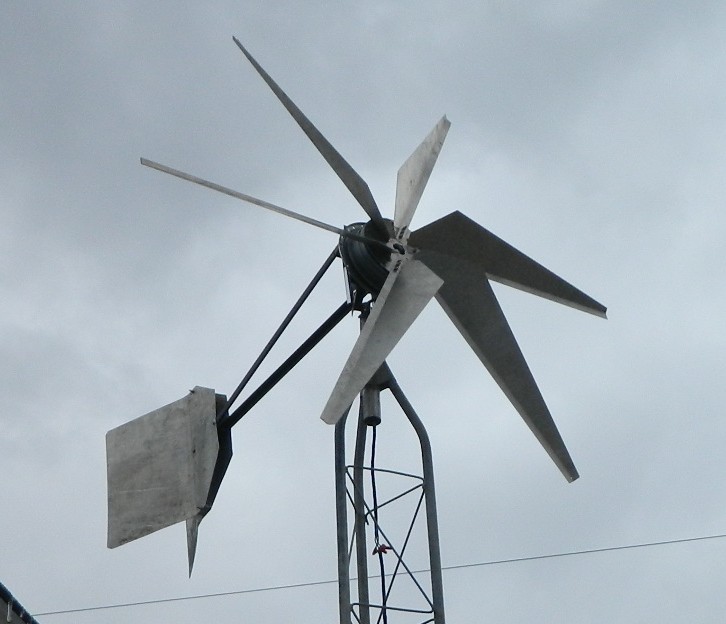
I reearched, designed and built my own windmills.
The best of these generated 45 watts on a good day,
and about 25 watts on an average day.
I paid about $500-750 for the materials,
and put in man, many hours building it.
I was absolutely thrilled! - Until I looked into solar panels.
I was paying over $10 per watt for electricity from my windmill,
while I could get solar panels that would provide electricity at a cost of about $1 per watt.
My experience has convinced me that wind may be great for utility scale power generation,
but solar is the way to go for the home owner,
especially if you live in a city like I do.
Buildings tend to block the wind and zoning laws restrict how high your windmill can be.
That's why I founded Easy Solar.
My best windmill produced 45 watts on a good day.
Not bad, but solar is more cost effective.
Solar Power at Rock Bottom Prices
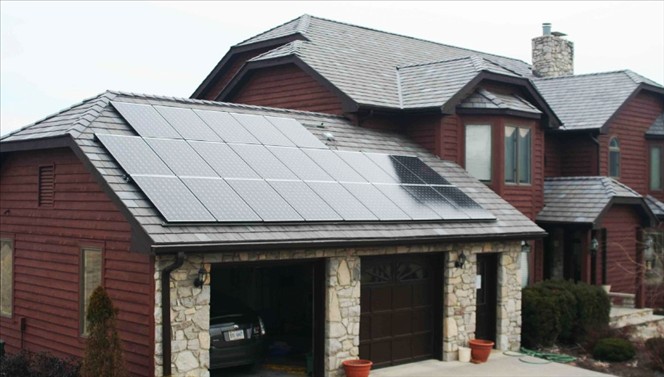
The goal of Easy Solar is to provide home owners with solar photovoltaic systems at rock bottom prices.
Obviously, if you can do some of the work yourself, that will lower your costs.
For most people a solar panel system which is tied to the elctrical grid makes the most sense.
The alternative is an off-grid system which requires batteries to provide power when the sun isn't available.
Batteries aren't cheap and drive up the system cost and complexity.
Many people believe that solar doesn't yet make economic sense,
but that isn't correct.
Let's do the math.
Solar Power Economics
You can find the average electricty rates for each state by visiting
ElectricChoice.com.
For simplicity, we'll assume the cost per kwh (kilowatt-hour) is ten cents.
We can install a 2 kilowatt system for $6,495.
In central Indiana where Easy Solar is located,
we get about 4.5 hours of sun per day.
Overall system efficiency is typically about 77%.
(For a detailed breakdown of this efficiency factor, visit
http://rredc.nrel.gov/solar/calculators/pvwatts/version1/derate.cgi).
That means on average the system will generate 2,000 X 4.5 X .77 / 1000 = 6.93 kwh each day,
which is about $0.69 worth of electricity.
For the year this will be 365 * $.69 = $251.85
At this point you may be thinking:
Henry, it's going to take $6,495 / $251.85 = 25.79 years to get my money back.
Now we factor in the tax credits and rebates.
Solar Power Tax Credits & Rebates
You can get all the details on the federal tax credit by visiting
EnergyStar.gov,
but what it says is that you get a 30% tax credit with no upper limit.
When you file your taxes the following year,
you will need to file
Form 5695.
Please note that this is a Credit not a Deduction.
This means that you will get 30% X $6,495 = $1,948.50 back when you file your taxes the following year,
which lowers your cost to $4,546.50 for the system.
What can really offset costs are the rebates that are offerred by utility companies.
You may be thinking, why would utility companies pay me to install solar panels?
Doesn't that mean they will be selling less power to me and lower their revenue?
Well let me explain how the power industry works.
The real cost drivers are power line maintenance and generating capacity.
The power utility companies are using deteriorating, aging and overloaded power lines,
as we consume more and more power than ever.
So utility power providers must find an inexpensive way to obtain extra power to its grid during peak hours.
Not only is it very expensive to build a new power plant,
but the utility has to come up with the money first,
then convince a regulatory commission it should be allowed to raise their rates (which is never popular)
to recoup their investment over time.
Generally, electricity usage goes up a little bit each year.
If they can entice enough home owners to add solar panels,
they won't need to build a new power plant.
Also, many states have requirements that force utility companies to get a certain percentage of their power from
renewable sources by certain dates.
In central Indiana, Indianapolis Power & Light currently has a
Renewable Energy Incentive Program
which expires at the end of 2013 (It is expected that they will have something similar in 2014).
The current program pays $2 per watt of photovoltaic generating capacity, up to a maximum of $4000.
When we factor this into our calculations,
the price for your system becomes $6,495 - $1,948.50 (Federal tax credit) - $4,000 (Utility rebate) = $546.50,
which means the sytems pays for itself in a little over two years.
It will pay off even sooner if electric rates rise, which they no doubt will.
Now if all these credits & rebates seem confusing, don't worry. Just give ole Henry a call or send me an email & I'll help you work
through it all.
My phone number & e-mail are at the bottom of this page.
Areas We Serve
Easy Solar offers a downloadable e-book for sale via instant download.
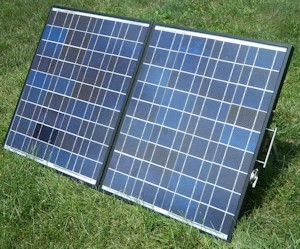
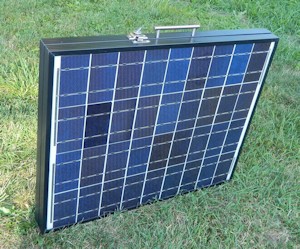
Our smaller products (like our 100 watt folding units for RVs) we can ship anywhere in the continental United States.
However at this thime we are unable to ship our larger products (like our 1,000 watt solar panel systems),
so we offer convenient local pickup only at our Indianapolis, Indiana location
(Map).
For more information, please contact Henry Walton at 317-667-6613 or email me at henry@diy-solar-panels.com
Easy Solar
Making DIY Solar Panels Simple
Contact:
Henry Walton
(317) 667-6613
henry@diy-solar-panels.com